Digital loyalty cards for coffee shops: how to get more customers coming back
Cardboard coffee cards get lost and tell you nothing about your customers. Here's how a digital loyalty card in Apple and Google Wallet works at the counter, and what it does for your shop.
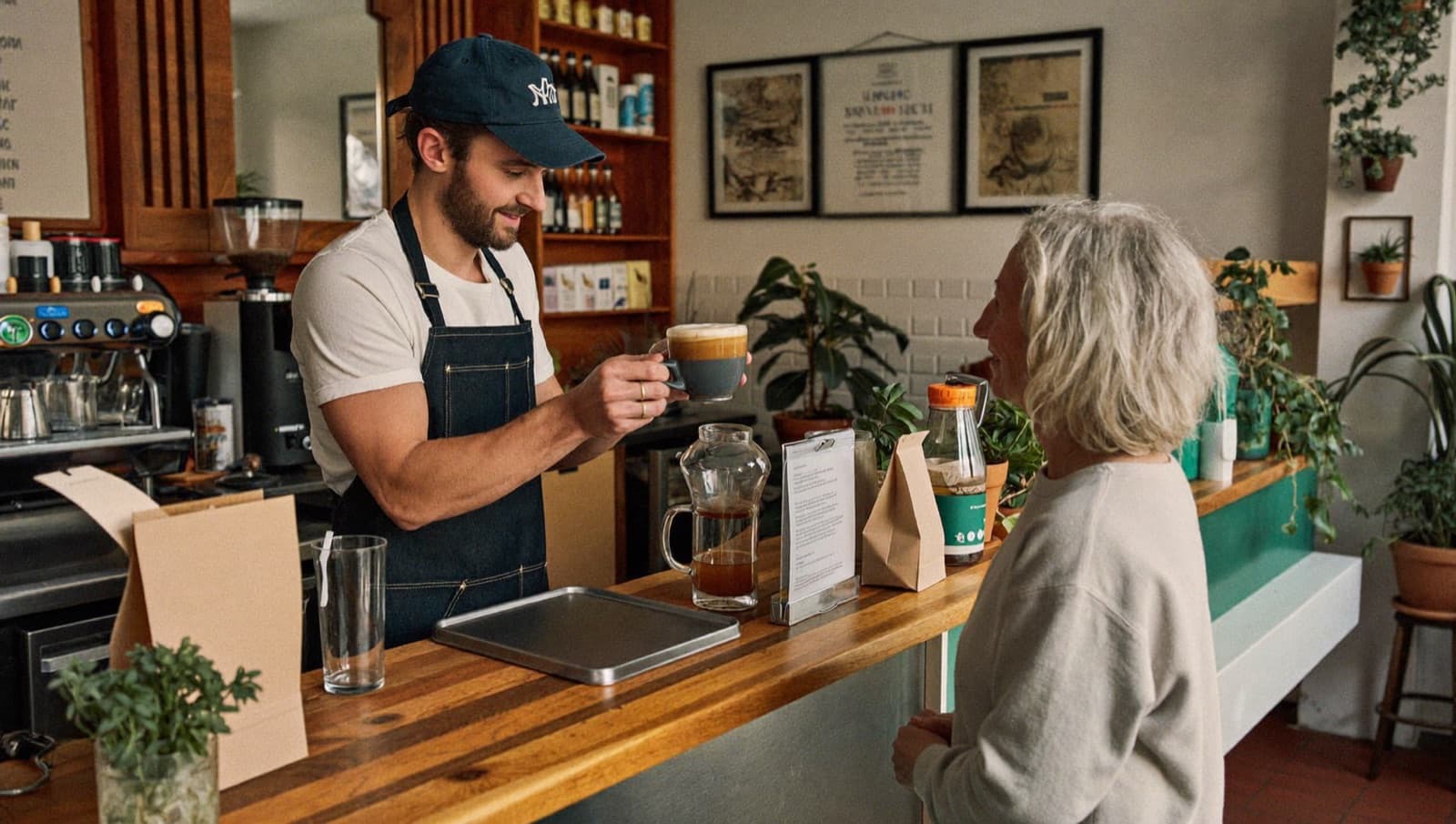
Most coffee shops don't run on tourists or people passing by. They run on regulars: the man who picks up his cappuccino every weekday at quarter past eight, the two friends who always take the window table on Saturday. Those customers come back out of habit, and habits can be nudged.
That's what the loyalty card was invented for: buy nine, get the tenth free. It works, but the cardboard works against you. Cards disappear into coat pockets, the stamp dries out, and you have no idea who is carrying one. A digital loyalty card for your coffee shop solves exactly those three problems: the card lives on the phone your customer is already holding, the counting takes care of itself, and for the first time you can actually reach the people who keep your business running.
Below you'll find how it works at the counter, which offer works best in hospitality, and how to go live in a week without slowing your baristas down.
Why a returning customer is worth more than a new one
Do the maths for your own shop. Someone who comes in twice a week and spends four euros a visit is worth well over four hundred euros a year. Get that same person in three times a week and you're past six hundred. You don't need a flood of new faces to grow; you need the people you already know to show up slightly more often.
Research into loyalty programmes has shown for years that keeping an existing customer is roughly a multiple cheaper than winning a new one. In practice we see it most clearly in the morning: the gap between your shop and the one across the street is small, and a single extra reason can tip the choice your way.
What a digital loyalty card actually is
A digital loyalty card is a pass that sits in the customer's phone wallet: Apple Wallet on an iPhone, Google Wallet on Android. That's where boarding passes, train tickets and cinema tickets live too. Your card simply sits among them, with your logo, your colours and the name of your shop.
No app to download
This is the crucial difference with the loyalty apps run by the big chains. Your customer installs nothing and creates no account. They scan one QR code, tap "add to wallet" and they're done. Ask someone holding a hot flat white to download an app and you've lost them; ask them to scan once and it almost always works. There's more on how that scan flow works in the piece on the QR code loyalty card.
The card updates itself
The moment you add a stamp, the card in your customer's phone changes. Not later, immediately. And with that update comes a notification on the lock screen: "2 more coffees until your free one." That's a message people don't read as advertising, because they just did something to earn it.
Paper coffee card versus digital card
The honest comparison, without the sales talk:
| Topic | Paper coffee card | Digital loyalty card |
|---|---|---|
| Lost cards | Happens constantly; the customer starts over or you give in | Can't happen; the card is on the phone and easy to find |
| Cost per card | Printing, stamps, ink, a reprint for every change | No printing; you make changes yourself in a few taps |
| Contact with the customer | None at all; you don't know who holds a card | A lock-screen notification with every stamp and campaign |
| Fraud | Copying a stamp or a card is trivial | Every stamp is tied to a scan and a timestamp |
| Insight | You're guessing how many cards are out there | You see how many cards are active and how often people return |
| Changes | A new offer means a new print run | Change it instantly, including cards already in circulation |
If you want that trade-off in more depth, including what to do with cards already in the wild, read digital versus paper loyalty cards.
How it works at the counter
A new customer
There's a small sign or sticker with a QR code on the counter. The customer scans it, enters their name, taps "add to Apple Wallet" or "add to Google Wallet" and has an empty card. It takes about twenty seconds and your barista does nothing at all. Put the sign where people are already standing around: at the till, or next to the milk and sugar.
A returning customer
The customer opens their wallet, you scan the code on their card with the phone or tablet behind the bar, and the stamp lands. One action, about as quick as a card payment. This matters during the morning rush: it doesn't have to happen while they order. Let them scan when they pay, or while their coffee is being made.
A full card
The customer gets a notification that their reward is ready. At the counter you scan again, the reward is redeemed, and the card starts from zero. No loose vouchers, no debate about whether there were eight stamps or nine.
What to put on the card
The offer decides whether this works. Three things that make the difference in practice:
- Keep it reachable. Ten coffees for a free one is the classic, but for a shop that mostly gets afternoon trade it's too far away. Six or seven is fine, and you can always adjust it later.
- Give the first stamp away. A card that starts at one instead of zero feels like something already in motion, and people finish what they've started.
- Reward something with margin. A free coffee costs you little and feels like a lot. A free lunch sounds generous but eats your margin and attracts people who only come for the reward.
Think about your quiet hours too. A double stamp between two and four in the afternoon moves visits to the moment your baristas are standing around anyway. You'll find more examples worked out specifically for hospitality on the page about loyalty cards for coffee shops.
The lock-screen notification is your cheapest channel
This is the part paper can never do. Because the card sits in the wallet, you can reach your regulars without an advertising budget and without depending on who happens to see your post on social media.
What you do with it is up to you: a message when it's raining and your terrace is empty, an announcement of the new single origin, or a gentle nudge to someone who hasn't been in for six weeks. The rule is simple: only send something when there's something in it for them. One well-timed message every two weeks beats three a week that people swipe away.
Beyond stamps: points and coupons
Not every shop fits a stamp card. If you sell lunch, pastries and beans alongside coffee, a points card makes more sense: the customer earns points per euro spent and redeems them for whatever they want. That way the person on a two-fifty espresso isn't treated the same as the table spending thirty euros on lunch, which is only fair.
You can also hand out standalone coupons: a discount for your opening week, a free pastry on a regular's birthday, or an offer sent only to the people who haven't been in for a while.
Live in five steps
- Day 1: create an account, upload your logo and pick your colours.
- Day 1: set up the card: how many stamps, which reward.
- Day 2: print the QR code and put it by the till.
- Day 2: brief your team in two minutes; "would you like to collect for a free coffee?" is the entire script.
- Week 1: check how many cards were created and send your first message.
You can start for free. The entry plan costs nothing and exists so you can see whether your customers join in before you pay for anything; what the paid plans cost is on the pricing page.
Frequently asked questions
Do my customers need to download an app?
No. The card goes into Apple Wallet or Google Wallet, which are already on virtually every phone. Your customer scans one QR code and taps add. No download, no password, no account.
How long does scanning take during the morning rush?
About as long as a card payment: a few seconds. You don't type anything. If it's genuinely busy, let people scan while their coffee is being made so it never sits in the ordering queue.
What if a customer forgets their phone or the battery is dead?
You can add the stamp manually from your dashboard afterwards, or they collect it next time. Unlike cardboard, nothing is ever lost: everything they've collected stays where it is.
Does this work for a business with several locations?
Yes. One card can be valid across all your locations while you still see per site where stamps are collected and rewards redeemed. To the customer it feels like one business, which is exactly the point.
Getting started
Before you set anything up, it helps to know what this could be worth in your case. Take the short quiz at find out what a loyalty card would do for your business: you enter how many customers you serve on an average day and what they spend, and you immediately see what a few extra visits per customer per year add up to. After that you'll know whether it's worth your time, which is a better starting point than another stack of printed cards.
Quer experimentar?
Crie o seu próprio cartão de carimbos digital em 5 minutos. Comece grátis, sem aplicação.
Veja a solução para cafés e cafetariasArtigos relacionados
Klantfeedback automatiseren: zo regel je het als salon, café of winkel
Klantfeedback automatiseren zonder de regels van Google, de ACM of de AVG te overtreden: het juiste moment, de kanalen en een stappenplan voor het mkb.
Loyalty Program Names: 60+ Ideas and How to Pick One
Need a name for your loyalty or rewards program? See 60+ ideas for cafes, salons and shops, plus a simple method to choose one customers remember.
Cafe Loyalty Program: How to Build One That Brings Regulars Back
How to set up a cafe loyalty program in the Netherlands: which format works, what it costs, how to stay AVG compliant, and how to get the second visit.